


Three weeks after a massive 7.8 earthquake hit Nepal—followed by one of nearly the same magnitude last week—the South Asian nation remains in shambles, with an eye on upcoming monsoon season that could make life go from bad to worse.
Donations have been pouring in, and the government is doing what it can to help the thousands of homeless and injured Nepali people. For its part, Chabad of Nepal, which was thrust into the midst of rescue-and-relief efforts immediately after disaster struck, continues to assist locals as most of the Israeli and other tourists have left the country.
One major goal right now is to construct stronger dwellings for those living in open fields and makeshift “tent cities.” That comes in the form of sturdy, waterproof tents and tin roofs on existing shelters to prepare for the winds and heavy rains expected with the start of monsoon season next month.
Rabbi Chezky Lifshitz, co-director of Chabad of Nepal with his wife, Chani, notes that the Chabad House in Kathmandu has also suffered some damage, estimating repair costs at $20,000.
But the emphasis remains on the hundreds of thousands of people who have lost their homes in the earthquake and the subsequent tremors that continue to rattle Nepal and agitate already damaged buildings.

“We are helping to rebuild villages that were destroyed,” says the rabbi, turning sights on long-term survival. “We brought in contractors from Israel who are experts in the field of quick construction, who can build a home within 10 days. Many are left with no roofs over their heads, and we want to rebuild as much as possible before monsoon season in just a few weeks.”
Food, Medicine and More
While Chabad is far from the only aid organization assisting on the ground, it proved crucial in rescuing stranded tourists after the initial earthquake, and feeding and housing anyone coming to the center for help.
Lifshitz notes that people have responded to calls for waterproof tents—hundreds have been distributed—but more permanent structures are still needed.
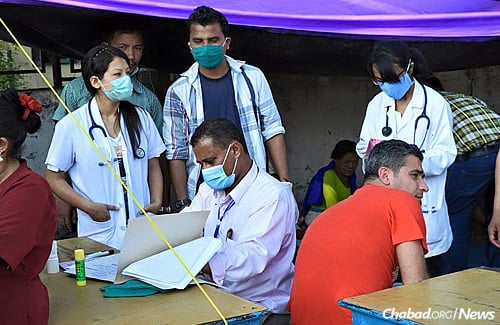
Food and medical supplies also remain a concern. According to the Lifshitzes, some isolated places still don’t have adequate food, so Chabad has been sending out food packages, as the government is overwhelmed with immediate needs.

An estimated 30 to 40 people are still at the Chabad House, which, while still standing, has been damaged by the quakes. Says Lifshitz: “It’s possible that after inspection, we may need to move to a different place.”
The couple sent their three young children to Israel weeks ago to stay with their grandparents.
Noting that most tourists have returned home, British volunteer Yehuda Rose, who has been helping in Nepal since shortly after the first earthquake, says those there are doing what they can in a tense and difficult time. He adds that local employees of the Chabad House have returned to their homes and villages to deal with matters there, and comfort their friends and families.

Meanwhile, in a posting on Facebook, Chani Lifshitz sought to explain what keeps them so motivated and focused. Noting that her grandmother was imprisoned in the Auschwitz concentration camp during World War II after having lost her home and family, what kept her going was her dreams—dreams of one day having someone to keep her warm, to feed her, to sing to her.
She correlated that to the situation of the Nepali people, that such dreams are what they have now.
Lifshitz writes: “Yes, it’s possible to take everything from a person, aside from [their] dreams. And that good people that will come and actualize [those] dreams.
“May we merit to be on the side of the giver who actualizes dreams.”
To help with the earthquake relief effort, visit the special relief fund page: www.Chabad.org/Nepal.




Start a Discussion